Segway Navimow i2 AWD Review: No Wires, No Antenna
I tested the Segway Navimow i205 AWD on my own lawn. Here is how Network RTK, on-demand all-wheel drive, and VisionFence perform without boundary wires.

Written by
Zino
Some links on this page are affiliate links. If you buy through them I earn a small commission, at no extra cost to you.
The Segway Navimow i2 AWD completely removes both the perimeter wire and the rooftop RTK antenna base station from the setup equation. In my testing, it held its positioning down to two centimeters under thick trees, handled a wet 45 percent slope without tearing grass, and mapped my lawn in under fifteen minutes. If you hated the idea of burying copper cables or bolting antenna poles to your chimney, this is the machine that fixes both problems.
Traditional robotic mowers have always felt like an unfinished promise. You buy a convenience tool, but before it can mow a single blade of grass, you spend an entire Saturday on your knees pegging thin wire along your hedges. As I put it in the video, "If you hit that wire with a shovel, the whole system dies." Early wireless mowers solved that, but introduced a new annoyance: an external RTK reference antenna that required clear line of sight to the sky, often forcing you to mount a mast onto your roof or drill through exterior walls.

How Network RTK eliminates the base station
At the 2026 product launch event in Paris, Segway introduced its updated family of mowers, which includes the H2 series, the X4, and the i2 LiDAR models alongside the standard i2. The headline feature across these models is Tri-Frequency Network RTK (NRTK). Instead of relying on a physical base station staked into your flowerbed, the mower connects to correction data through cellular connectivity and cloud networks.
I call this the antenna killer. The mower receives standard satellite signals from overhead, but pulls its differential correction coordinates over the network. When combined with onboard vision SLAM (Simultaneous Localization and Mapping), the system tracks location with accuracy down to two centimeters. Even when I ran the machine directly along the edge of my fence and beneath dense tree canopies where direct satellite signals degrade, I saw zero dropouts and zero interruptions.
For anyone with a walled garden or tall trees surrounding the perimeter, that dual positioning setup is mandatory. Pure satellite tracking always drifts when tall structures block the sky. The camera picks up visual landmarks, cross-referencing visual data with network coordinates so the mower never wanders blindly into a flowerbed.
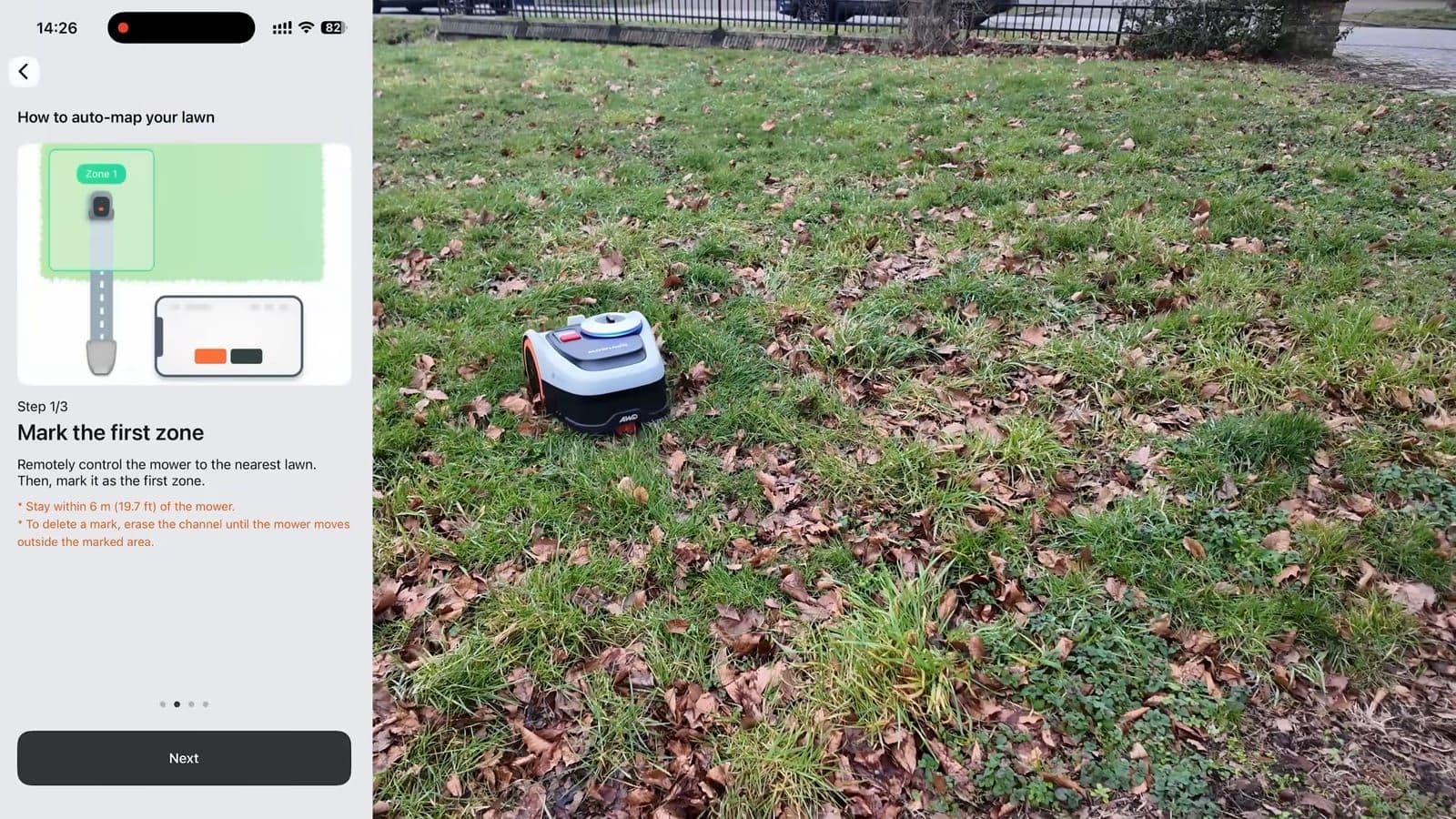
Real lawn testing and all-wheel drive performance
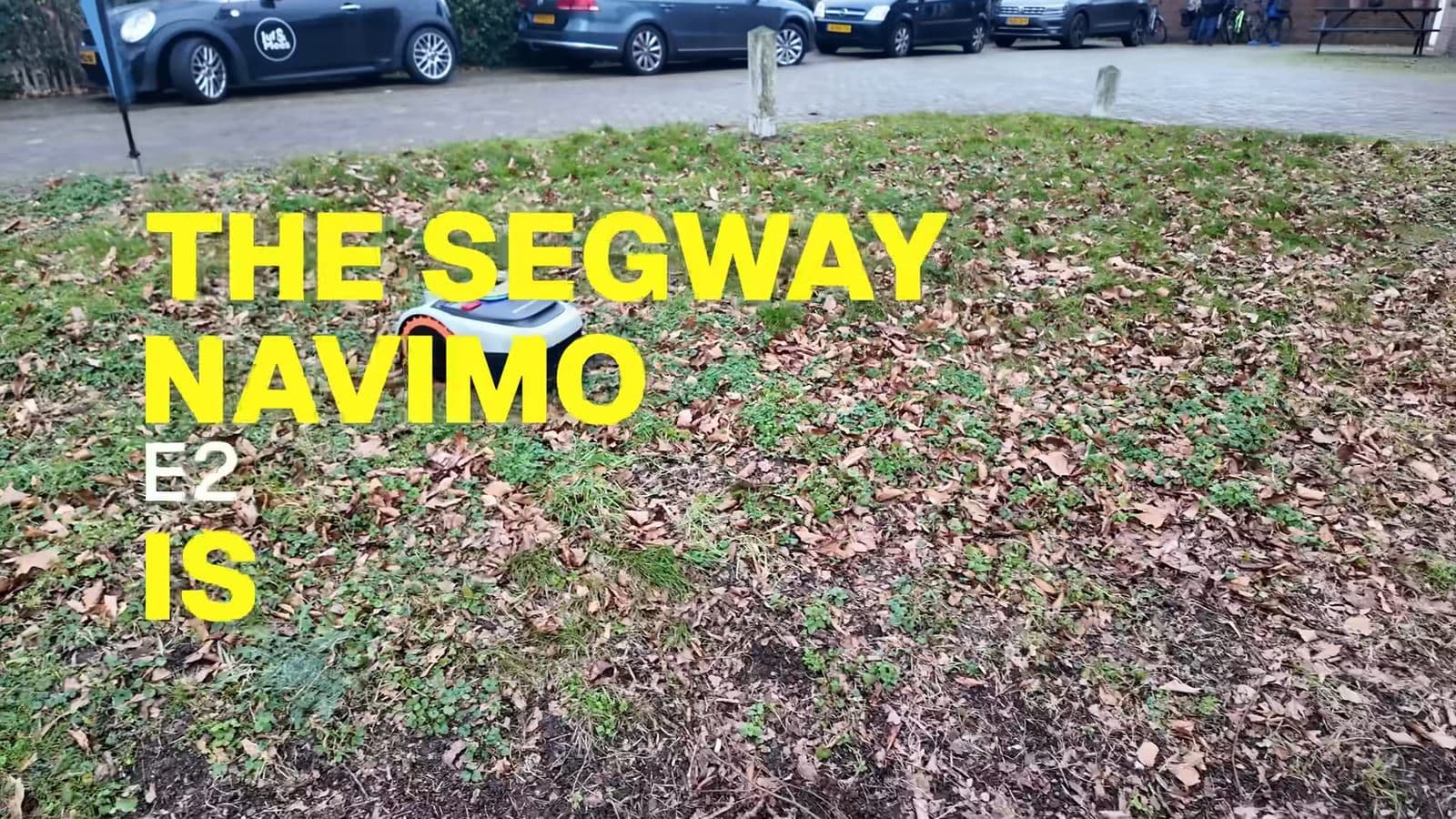
The model I tested at home is the i205 AWD, designed for gardens up to 500 square meters. Showroom floors in Paris are flat and easy, but my backyard has exposed tree roots, loose gravel borders, patches of damp moss, and steep transitions. Front-wheel-drive robot mowers often spin their wheels on damp grass, gouging muddy ruts into the turf.
The i2 AWD uses an on-demand all-wheel-drive system linked to Electronic Stability Control (ESC). In normal conditions on flat turf, it runs primarily on two wheels to preserve power. As soon as the onboard sensors detect slip on an incline or over slick foliage, the third drive wheel engages immediately. As I noted in my testing, this saves thirty percent of the battery energy compared to running full AWD continuously, while still conquering slopes up to 45 percent.
Watching it navigate damp patches covered with wet leaves confirmed the engineering works. The mower climbed our steepest grade without hesitating or sliding sideways. When reaching the boundary, it uses zero-turn maneuvers instead of harsh pivot scuffs, turning cleanly without grinding the root layer off the lawn.
Hardware specs and cutting deck design
Segway built the i2 with low-maintenance ownership in mind. The chassis is certified IP66 water and dust resistant. That means when wet grass and muck stick to the undercarriage after an autumn trim, you do not have to brush it by hand with a dry cloth. You flip it up and spray it down with a garden hose.
Here are the core technical specifications of the Navimow i2 AWD:
- Positioning system: Tri-frequency Network RTK (NRTK) combined with Vision SLAM
- Positioning accuracy: down to 2 cm
- Drive mechanism: On-demand All-Wheel Drive (AWD) with Electronic Stability Control (ESC)
- Maximum climbing ability: up to 45% slope incline
- Recommended yard size: up to 500 m²
- Obstacle camera: 140-degree RGB camera with VisionFence AI
- Water resistance rating: IP66 water and dust protection
- Cutting blades: Reversible double-sided cutting blades
The cutting deck uses free-swinging reversible blades. You get three to five weeks of sharp cutting per side before you simply loosen the screws and flip them over to expose the fresh edge, doubling the lifespan of each blade set. The resulting cut produces straight, clean stripes on the lawn without ragged, brown blade tips.
Setting up zones with GeoSketch and everyday operation
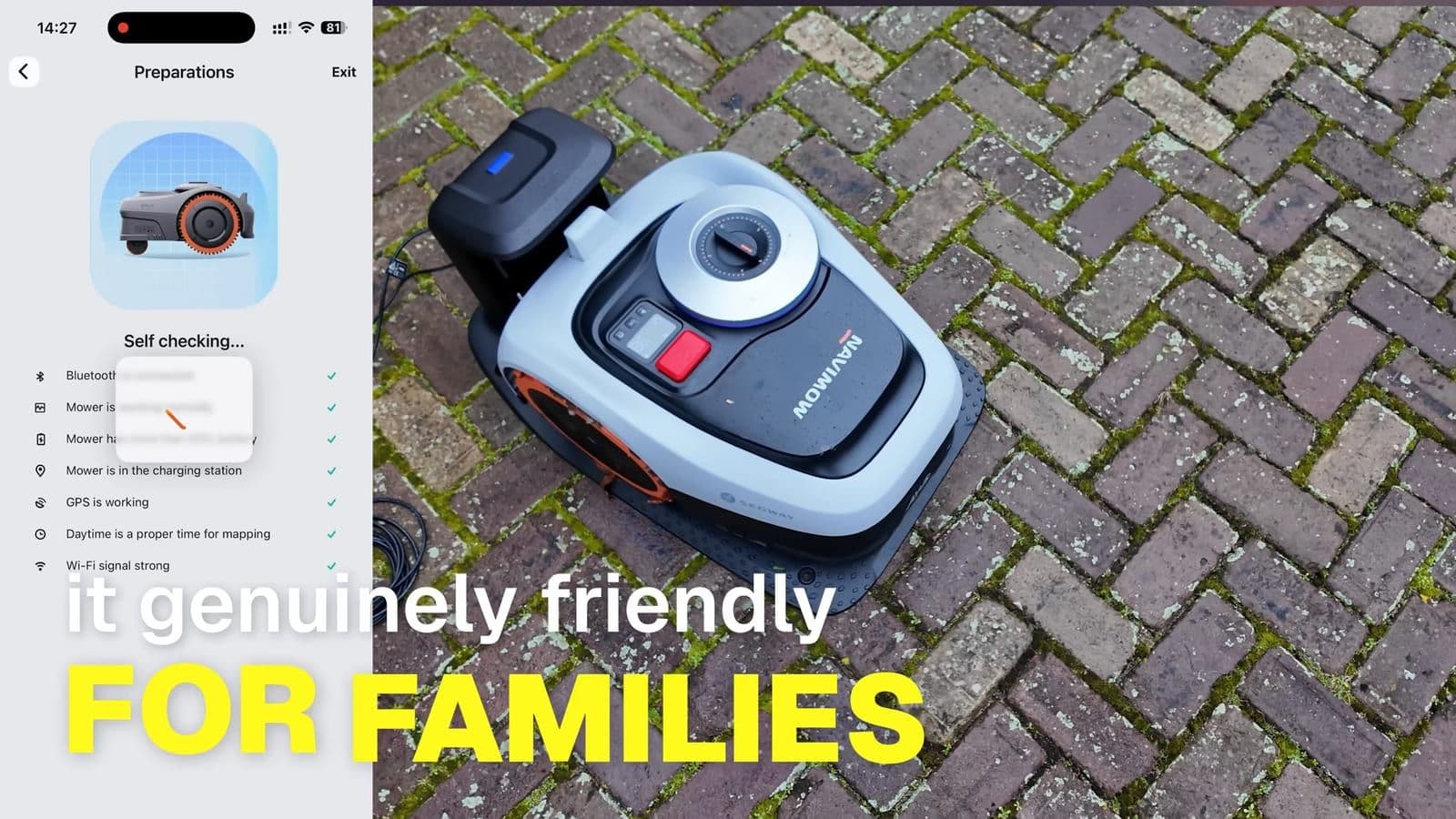
Setting up the mower out of the box took less than fifteen minutes. Navimow includes a Drop and Mow auto-mapping feature where the mower charts boundaries automatically, but you can also walk the perimeter using GeoSketch in the mobile app. You control the robot like a miniature remote-controlled car using your phone screen, driving it along the perimeter of your turf, defining channels across brick driveways, and circling off-limit flowerbeds.
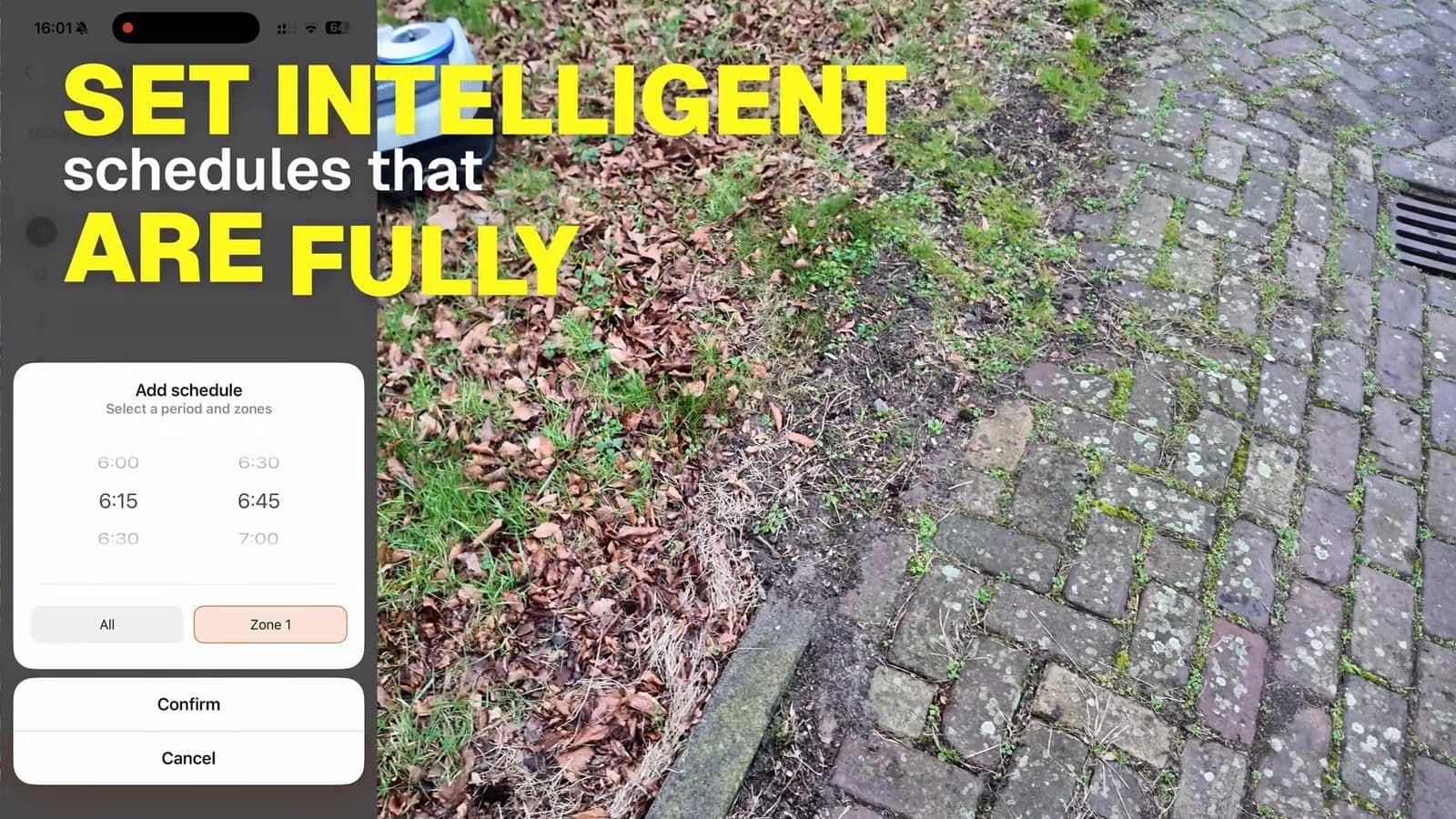
The app lets you build multiple distinct mowing zones and assign unique mowing schedules to each. Built-in weather adaptive settings pause scheduled cuts if the system detects heavy rain, freezing temperatures, or frost, avoiding turf damage.
Obstacle detection relies on the VisionFence AI camera, which has a 140-degree field of view trained on over 150 household yard objects. During the day, it easily avoids garden hoses, footballs, stray shoes, and dogs down to roughly three inches in size. It glides around them without bumping into them.
My experience was slightly more mixed when testing late in the evening. Segway provides a Night Mowing mode, but because VisionFence relies on optical camera inputs, recognition degrades in deep shadows. Tiny items like golf balls or small garden pegs can still be missed in low light, so you will want to do a quick sweep of the grass before sending it out after dark.
As of February 2026, Segway launched the i205 AWD with an introductory promotion running from 3 February to 16 February, offering 50 euros off and a bundled protective garage accessory valued at 149.90 euros. You can check current pricing directly on Amazon or visit the Navimow website for regional availability.
Who should buy this and who should skip it
Buy the Segway Navimow i2 AWD if you have a yard up to 500 square meters with tricky terrain. If your garden has slopes up to 45 percent, tall hedges, overhanging trees, or separated patches of grass connected by pathways, this mower handles them without breaking a sweat. It is especially suited for anyone who outright refuses to mount an antenna on their house or dig boundary wires into the ground.
Skip the i2 AWD if your lawn is significantly larger than 500 square meters. For bigger properties, look toward larger capacity models like the Navimow H2 or X4 series. You should also skip it if you have a completely flat, postage-stamp garden and a strict entry-level budget, because paying for all-wheel drive and tri-frequency cellular positioning is unnecessary if a basic manual push mower takes you five minutes on a Sunday.
Frequently asked questions
How does Segway Navimow Network RTK work without an antenna?
Network RTK replaces the traditional outdoor base station by receiving satellite corrections over cellular data. The mower pairs these networked correction signals with its onboard RGB vision system to maintain positioning down to two centimeters, even when tall buildings or tree branches shade the satellites.
Can the Navimow i2 AWD handle steep and wet slopes?
The i2 AWD manages inclines up to 45 percent using on-demand all-wheel drive and electronic stability control. It engages its third drive wheel when it detects slipping on wet turf, providing solid traction without chewing up the grass during zero-turn maneuvers.
How small of an object can the VisionFence camera avoid?
The 140-degree VisionFence camera reliably detects and detours around objects larger than three inches (7.6 cm), including toys, pets, and tools. Small, low-profile items like golf balls should still be picked up manually before starting a mowing cycle, particularly when running the mower in dark conditions.
Get new reviews in your inbox
One email when a new review goes up. No spam, unsubscribe with one click.
Comments0
No comments yet. Be the first.