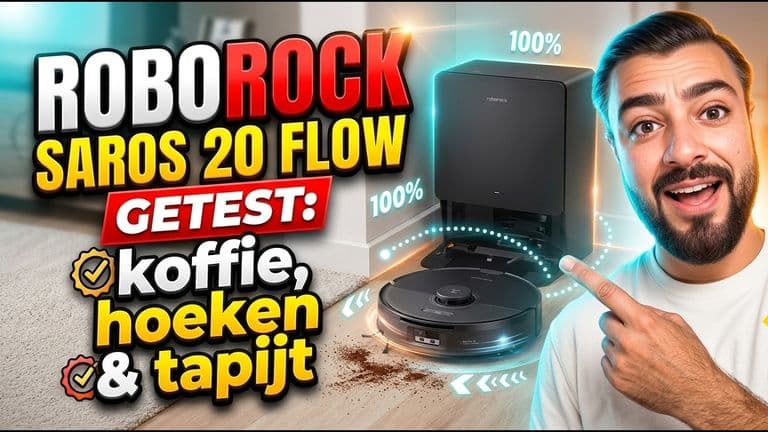
Roborock Saros 20 Review: Is Extreme Suction Worth It?
Ik testte de Roborock Saros 20: met 36.000Pa zuigkracht, AdaptiLift tot 8,8 cm en een lage 7,98 cm behuizing zonder LiDAR-toren. Dit zijn mijn bevindingen.

Written by
Zino
Some links on this page are affiliate links. If you buy through them I earn a small commission, at no extra cost to you.
The single most impressive thing about the Roborock Saros 20 is that it actually climbs over obstacles instead of crying for help in the middle of your living room. For years, robot vacuum brands have kept pumping up numbers on spec sheets while the actual hardware still gets stranded on a standard door threshold or tangled in a loose charging cord. The Saros 20 solves that specific headache by redesigning the physical suspension and removing the bulky top radar turret entirely.
Robot vacuums have been promising completely hands-off cleaning for a long time, but they have basically been stuck in a loop. As I mentioned in the video, "The second they hit a real-world obstacle, they turn into a thousand-euro paperweight." You end up babysitting a device that was supposed to save you time. Roborock built the Saros 20 to tackle those exact physical bottlenecks.
How the AdaptiLift chassis tackles door thresholds and steps
Most modern robot vacuums give up the moment a threshold is taller than 2 cm. They hit the wooden strip, scrape the bumper against the edge, spin their drive wheels in place, and eventually shut down with an error code. If you live in an older house with raised door transitions between rooms, you usually have to pick the robot up and carry it around manually.
Roborock solved this with what they call the AdaptiLift Chassis 3.0. Instead of a rigid undercarriage, the Saros 20 uses an independent lifting suspension paired with climbing arms. When the front sensors detect an obstacle or a stepped threshold, the robot does not just ram into it. It lifts its front body up, plants its auxiliary support wheels onto the step, and pulls the drive wheels up after it.
"The best way I can describe it is it's doing pull-ups." Under specific test conditions, it can conquer multi-layer thresholds measuring up to 8.8 cm (specifically a 4.5 cm step followed by another 4.3 cm step). In real living spaces, this means it walks right over the thick wooden transition strips and heavy room dividers that trap virtually every other vacuum on the market.
StarSight 2.0 navigation and fitting under low furniture
Take a look at almost any premium robot vacuum built in the last five years and you will see the same thing: a raised plastic puck sitting right in the center of the top lid. That rotating LiDAR turret works well for mapping, but it adds height. Because of that dome, most robots measure between 9.5 and 10.5 cm thick, meaning they instantly jam against low couch skirts, kitchen cabinet kicks, and bed frames.
Roborock basically killed the turret on this model. The Saros 20 is just 7.98 cm tall. They achieved that by switching to the StarSight Autonomous System 2.0, which relies on a dual-transmitter solid-state 3D Time-of-Flight setup embedded right into the front bumper. The sensor array maps 21,600 measurement points at 38,400 scans per second, giving it real 3D spatial vision rather than a flat 2D slice of the room.
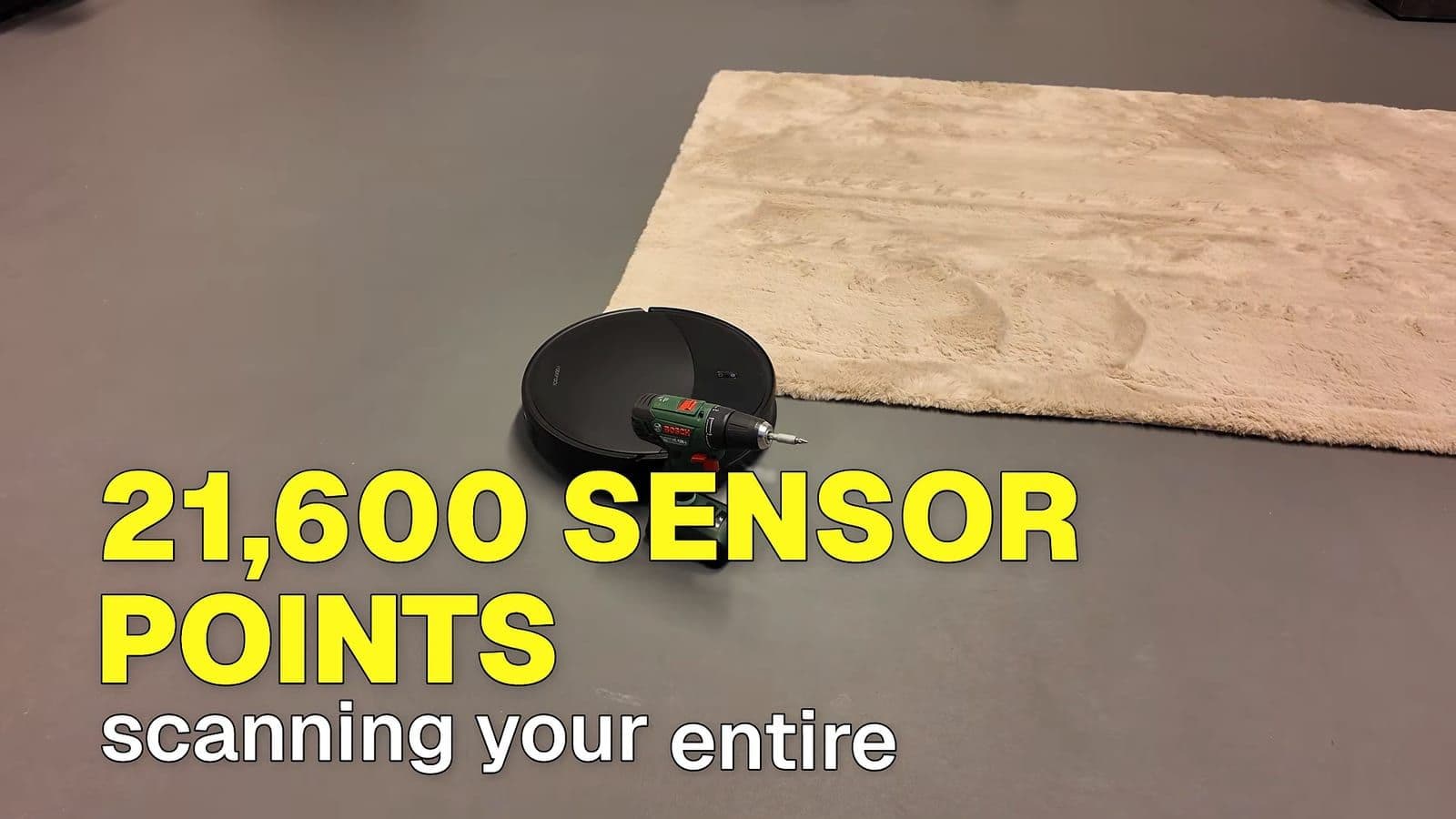
Because the sensor scans in true three dimensions, it identifies over 300 types of household objects. During my testing, I scattered power drills, tape measures, loose wires, and small toys across the floor. The Saros 20 steered cleanly around every single one without nudging them across the tiles. More importantly, that 7.98 cm clearance lets it slip into spots as low as 7.95 cm under my kitchen counters where dust and crumbs normally sit untouched for months.
36,000Pa suction and the DuoDivide brush system
The headline figure on the box is 36,000Pa of suction from the HyperForce digital motor. That is a massive number on paper, basically a jet engine packed inside a plastic circle. But raw suction numbers do not mean much if the intake gets choked with tangled hair after three cleaning runs.
"The most annoying part of robot vacuums isn't emptying the bin, it's pulling out the brush and cutting hair off like you're doing surgery." Anyone with pets or long-haired family members knows the drill of sitting over the trash can with a pair of scissors every weekend.
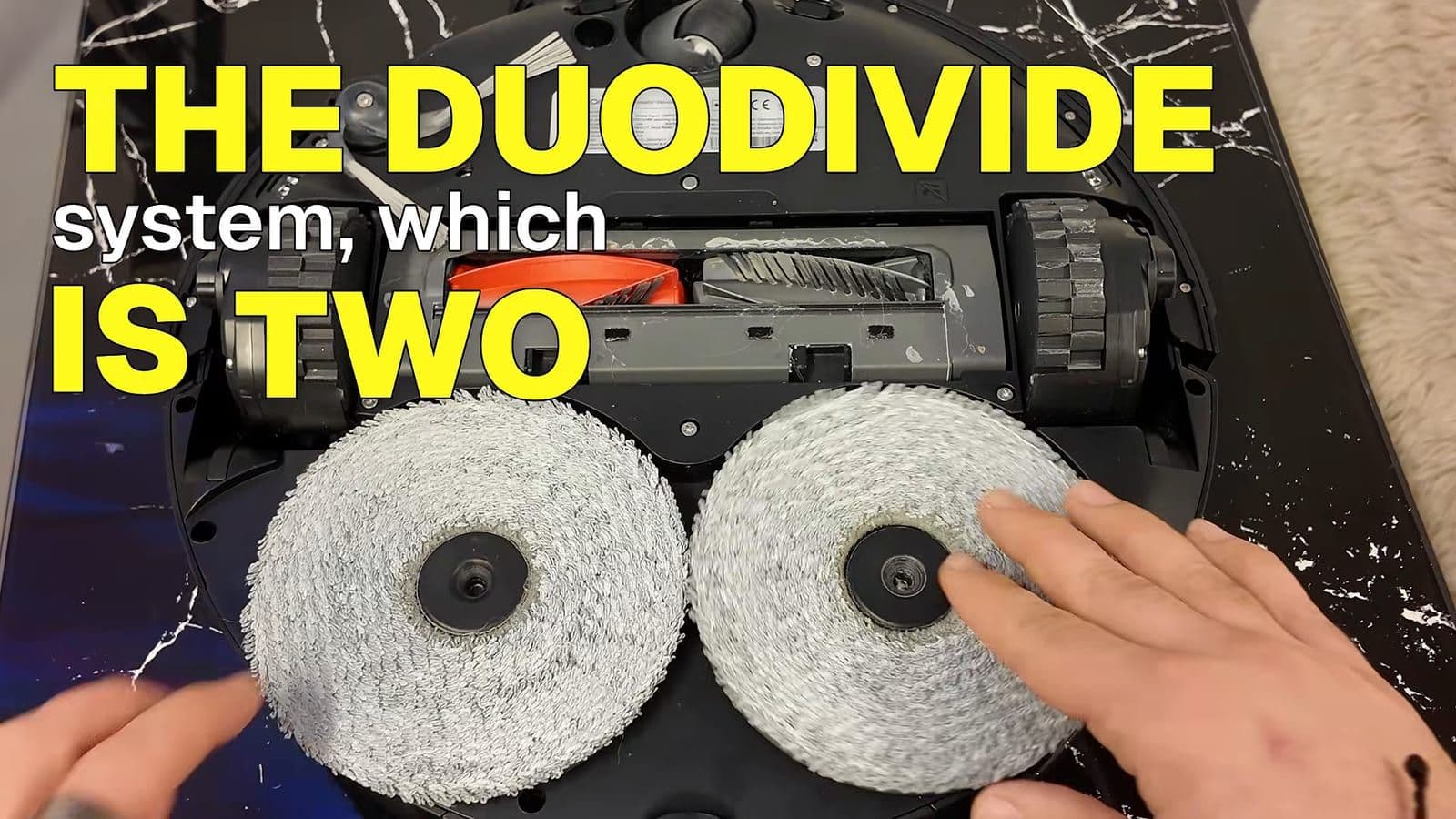
To prevent that, Roborock uses the DuoDivide system. Instead of one long cylindrical roller, the brush assembly consists of two split, counter-rotating rubber rollers. Both rollers taper inward toward a central gap. As pet hair and lint are swept up, the rotational geometry forces strands toward that center gap instead of letting them wrap around the axle bearings. The hair slides straight into the high-velocity suction path and into the dustbin. After several heavy cleaning runs, the roller ends remained completely clean.
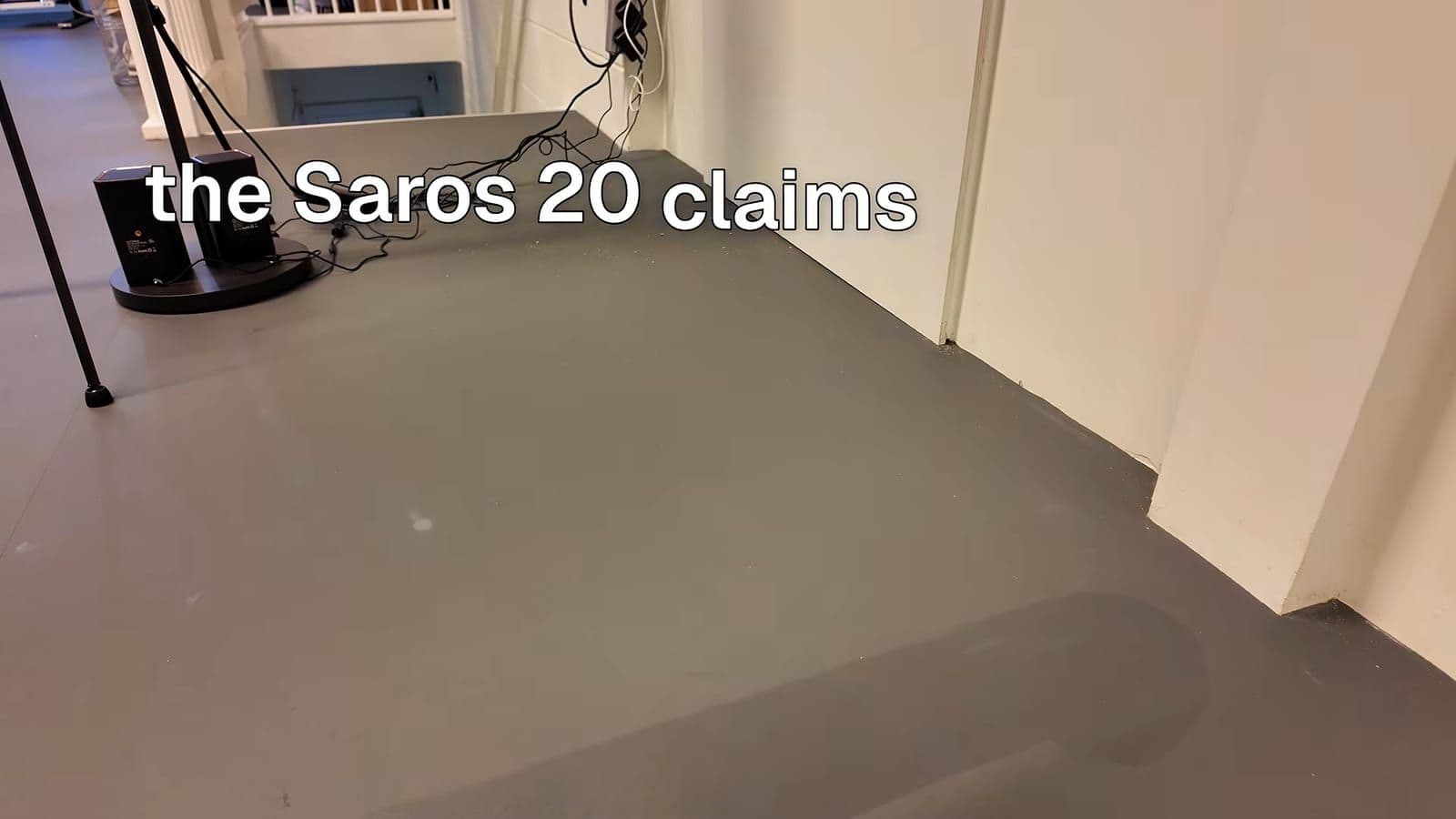
For baseboards and tight corners, the Saros 20 pairs this brush layout with a FlexiArm side brush. When the robot detects an inside 90-degree corner or a wall edge, the robotic arm physically swings outward to flick debris out of the seam and right into the path of the main rollers.
Dual spinning mops and the 100°C self-cleaning dock
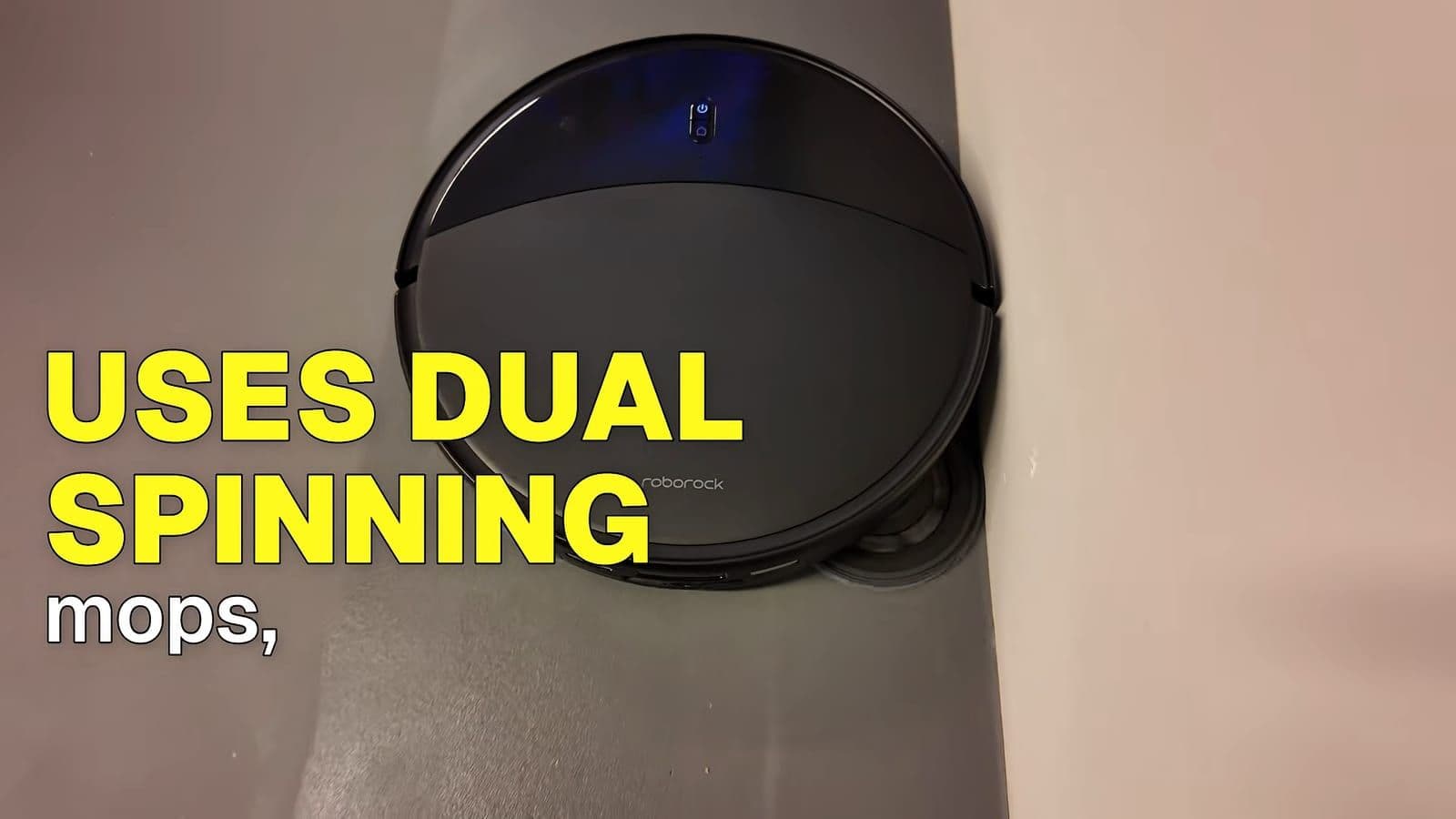
For hard floors, the Saros 20 relies on dual pressurized spinning pads that scrub against tile and hardwood. Much like the side brush, the right mop pad sits on a motorized FlexiArm mount. When the vacuum hugs baseboards or cabinet kicks, the mop kicks outward into the corner, eliminating the dirty unmopped strip that round robots usually leave behind.
Once the pads pick up grime, the robot returns to the multi-functional docking station. The dock washes the pads using 100°C boiling hot water, though you need to enable this high-temperature wash setting inside the mobile app. Standard cold or lukewarm mop rinses just smear kitchen oil around. The boiling water actually cuts through grease and sanitizes the fabric, which keeps the base station from developing that musty wet-rag smell.
If you have carpets, mop lifting is usually where things go wrong. Most robots can only lift their pads by 10 to 15 mm, which is not enough clearance for medium or high-pile rugs. They end up dragging damp, filthy mop cloth across your carpet fibers.
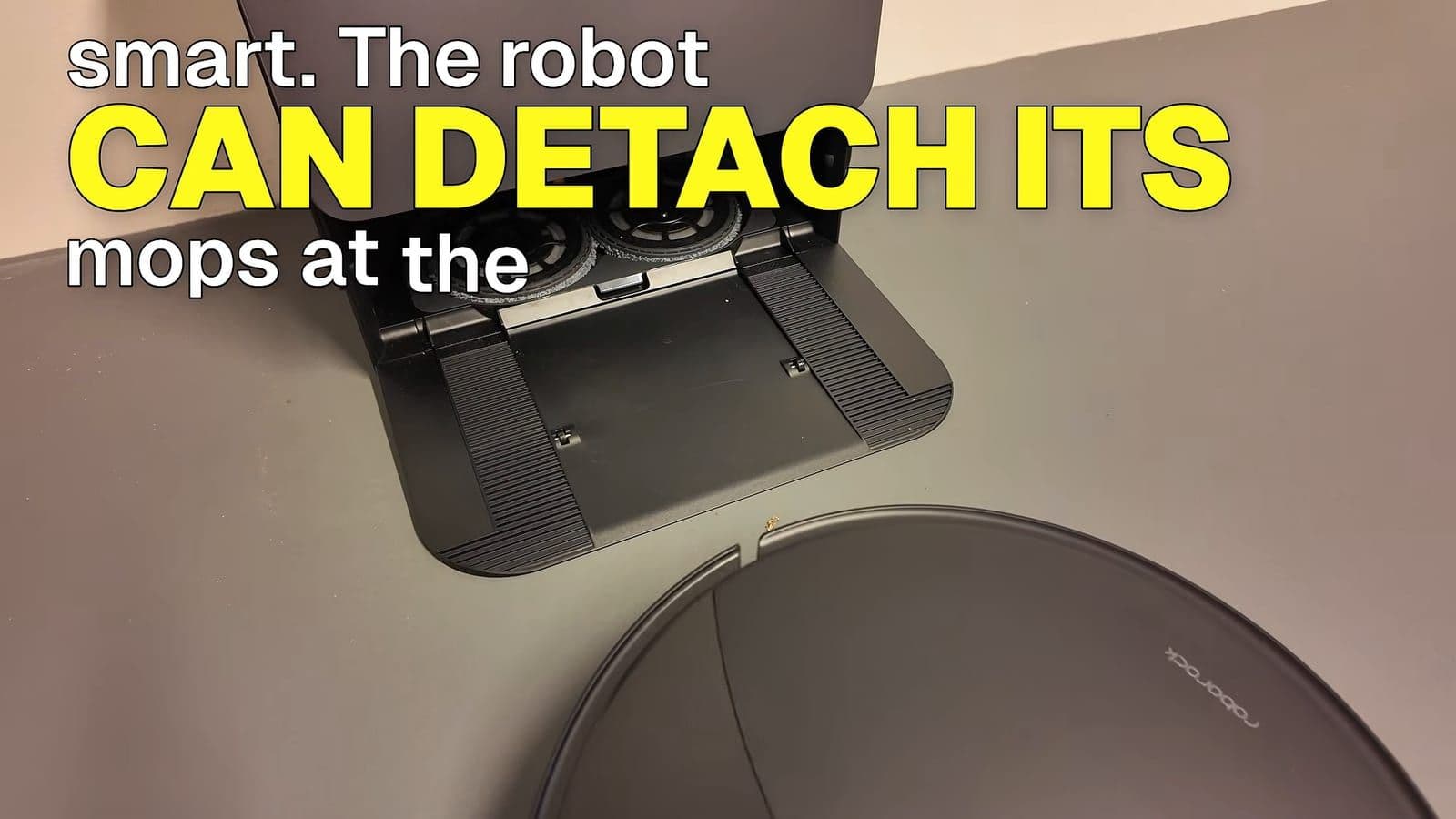
The Saros 20 handles this properly by using automatic mop detachment. When you schedule a carpet-first run or a vacuum-only run, the robot pulls into the dock, unclips the magnetic mop pads entirely, and leaves them sitting inside the base tray. It basically drops its shoes at the door, goes out with full suction to clean rugs up to 3 cm thick, and only snaps the wet pads back on when it returns to hard flooring.
SmartPlan 3.0 controls and data privacy
All of this hardware is tied together through the Roborock app and the new SmartPlan 3.0 system. The app gives you an absurd amount of fine-grained control: you can customize room-by-room suction levels, adjust mop dampness across multiple stages, set pad washing intervals by time or square meters, and configure specialized threshold climbing routines.
While tech enthusiasts will enjoy digging into those sliders, the sheer depth of menus can feel overwhelming. My advice is to leave SmartPlan on its automatic setting. On auto, the robot evaluates the floor type and dirt levels by itself, automatically dialing up suction over carpets and making a second pass over sticky spots.
For anyone worried about having optical sensors scanning their home, the entire StarSight system and companion app are certified by TÜV Rheinland for IoT security and GDPR compliance. The obstacle recognition processing happens locally on the machine, meaning real-time camera feeds are not being uploaded to remote servers.
Who should buy the Roborock Saros 20 and who should skip it
At retail launch, this is a premium flagship vacuum. When checked on 24 February 2026, the Saros 20 launched with a promotional price running from February 26 through March 8 at €1,289.00 on Coolblue (listed as the Saros 20X, regular price €1,489.00), and €1,289.00 on Amazon NL and Bol.com (listed as the Saros 20 Set, regular price €1,499.00).
You should buy the Roborock Saros 20 if:
- Your home has tall door thresholds, sunken rooms, or split-level transitions that constantly trap standard robot vacuums.
- You have low-clearance couches or beds where standard 10 cm tall turret vacuums cannot fit.
- You have mixed flooring with plush area rugs and do not want damp mop pads touching your carpets.
- You have shedding pets and want to stop cutting hair off roller bearings every week.
You should skip the Roborock Saros 20 if:
- You live in a compact, single-level apartment with flat floors and zero thresholds, where a mid-range vacuum does the job for half the price.
- You are on a strict budget and do not need extreme 8.8 cm climbing mechanics or boiling-water pad washing.
- You want a basic push-button cleaner without setting up Wi-Fi or managing mobile app routines.
Frequently asked questions
What is the difference between the Roborock Saros 20, Saros 20X, and Saros 20 Set?
The core robot hardware, suction motor, and climbing mechanics are identical across all three names. Retailers simply use slightly different listing labels and bundle packaging, such as Coolblue calling it the Saros 20X and Bol.com listing the complete package as the Saros 20 Set.
How high can the AdaptiLift Chassis 3.0 climb?
Under specific multi-step test conditions, the chassis can scale stepped obstacles up to 8.8 cm (tested as a 4.5 cm step followed immediately by a 4.3 cm step). For standard single thresholds, it easily clears common interior door transitions that stop conventional 2 cm robots.
Does the Saros 20 get carpets wet while mopping?
No, because it physically detaches its mop pads inside the docking station before cleaning carpeted zones. Instead of relying only on a small mechanical lift, the robot leaves the wet pads behind completely when you run a carpet-first or vacuum-only schedule.
How does the Saros 20 fit under low furniture without getting stuck?
Roborock replaced the traditional spinning LiDAR tower with a front-facing StarSight 2.0 solid-state 3D ToF array. This brings the total height down to 7.98 cm, allowing the vacuum to clean under furniture clearances as tight as 7.95 cm.
Get new reviews in your inbox
One email when a new review goes up. No spam, unsubscribe with one click.
Comments0
No comments yet. Be the first.